How to Improve Load Capacity of Conveyor Rollers
In heavy industries such as mining, cement, and bulk material handling, improving conveyor roller load capacity is a constant challenge. As production demands increase, conveyor systems are required to carry heavier loads while maintaining stability and efficiency. However, many conventional rollers struggle with deformation, structural fatigue, and reduced service life under continuous stress.
Addressing these issues requires not only stronger materials but also better structural design and manufacturing techniques. High-strength solutions that minimize deformation while maintaining long-term reliability are essential for modern conveying systems.
How Does Low Conveyor Roller Load Capacity Affect Performance?
Insufficient conveyor roller load capacity often leads to a series of operational problems that directly impact system efficiency and cost. When rollers are unable to withstand heavy loads, deformation becomes inevitable, which disrupts alignment and increases resistance during operation.
Over time, this can result in unstable conveying, uneven belt wear, and increased maintenance frequency. In severe cases, roller failure can cause unplanned downtime, leading to production losses and higher operational expenses.
These issues are particularly evident in high-load environments where continuous operation amplifies even minor structural weaknesses. Without adequate load-bearing capability, the entire conveying system becomes less reliable and more costly to maintain.
Why Do Traditional Rollers Deform Under Heavy Loads?
The root cause of deformation in many traditional rollers lies in both material limitations and structural design. Steel rollers, while widely used, are prone to deformation when subjected to prolonged heavy loads, especially if wall thickness or structural support is insufficient.
Another critical factor is the connection between different materials. In composite rollers, weak bonding between components can lead to internal stress concentration, which accelerates deformation and reduces overall strength.
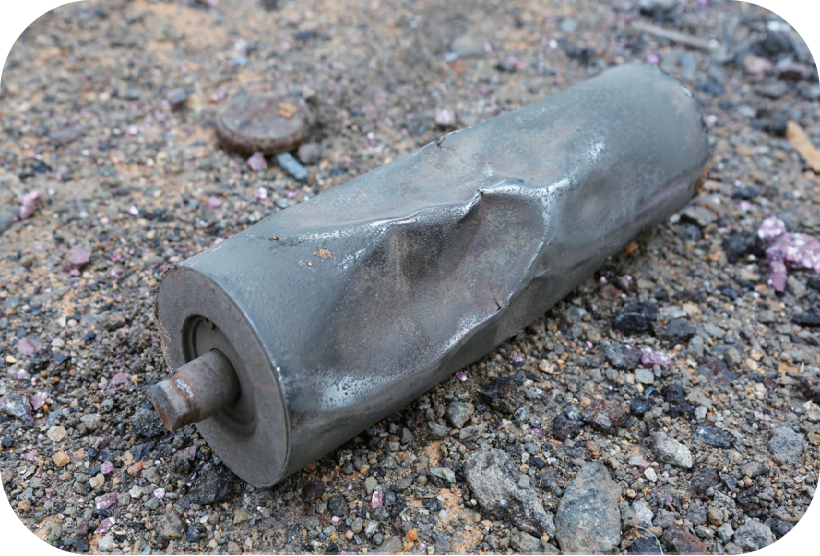
In addition, mismatched thermal expansion coefficients between materials can create micro-gaps or stress points over time. Under fluctuating temperatures and continuous load, these small inconsistencies can develop into structural instability, ultimately affecting roller performance and lifespan.
How to Improve Conveyor Roller Load Capacity and Reduce Deformation?
Improving conveyor roller load capacity requires a combination of material strength, structural integrity, and reliable bonding technology. Rather than relying solely on thicker steel components, modern solutions focus on optimizing the entire roller structure to achieve higher strength with better efficiency.
Key improvements typically include:
- Enhancing compressive strength through advanced materials
- Reducing deformation by improving structural stability
- Strengthening the bond between different components
- Ensuring compatibility in thermal expansion properties
By addressing these factors together, it is possible to significantly increase load-bearing capacity while maintaining dimensional stability over time. This not only improves system reliability but also allows for more efficient design configurations.
What Makes Jiulongbi Stone Rollers a High-Strength Solution?
Our Jiulongbi stone rollers are specifically engineered to enhance conveyor roller load capacity while minimizing deformation under heavy loads. By combining high-strength Jiulongbi stone with steel pipe structures, these rollers achieve a compressive strength of up to 297 MPa, providing exceptional resistance to pressure and long-term structural stability.
This high load-bearing capability makes it possible to optimize system design. For example, a conventional φ108 mm roller can be replaced with a φ89 mm roller without compromising performance. Such optimization not only maintains operational reliability but also helps reduce procurement and material costs.
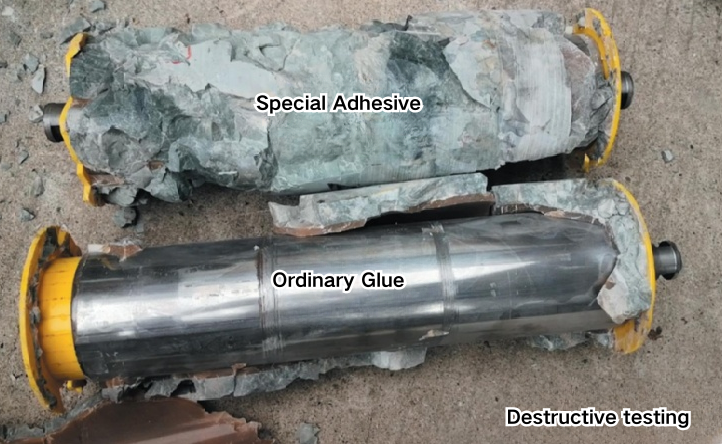
A key factor behind this performance is the advanced bonding technology used to integrate Jiulongbi stone with steel pipes. The specially developed adhesive, created in collaboration, has undergone multiple formulation upgrades to achieve a breakthrough in bonding strength. This ensures a highly stable and durable connection between materials, even under continuous heavy loads.
Equally important is the precise matching of thermal expansion coefficients between the adhesive, steel pipe, and stone substrate. This compatibility prevents internal stress caused by temperature variations, allowing the roller to maintain its structural integrity over time. As a result, deformation is significantly reduced, and long-term performance remains consistent.
Conclusion
Improving conveyor roller load capacity is essential for achieving reliable and efficient material handling in heavy industries. Traditional approaches that rely solely on thicker or stronger steel components are no longer sufficient to meet modern operational demands.
By integrating high-strength materials such as Jiulongbi stone with advanced bonding technology and optimized structural design, it is possible to achieve both high load-bearing capacity and minimal deformation. This not only enhances system performance but also reduces long-term costs through improved durability and smarter design choices.
For operations seeking a more efficient and reliable solution, high-strength conveyor rollers represent a practical upgrade that delivers both technical and economic benefits.
Get In Touch
Address
Unit 803, Qidu, Wushi Business Center, No. 768, Qishan North Road, Huli District, Xiamen, China
Email Us
sales@EnvisionRoller.com
Call Us
+86-592-2681031
+86-130-630-86860